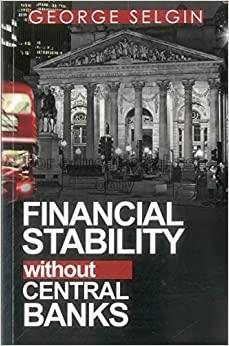
George Selgin is one of the world's foremost monetary historians. In this book, based on the 2016 Hayek Memorial Lecture, he shows how a system of private banks without a central bank can bring about financial stability through self- regulation. If one bank stretches credit too far, it will be reined in by the others before the system as a whole gets out of control. The banks have a strong incentive to ensure an orderly resolution if a particular bank is facing insolvency or illiquidity. Selgin draws on evidence from the era of 'free banking' in Scotland and Canada. These arrangements enjoyed greater financial stability, with fewer banking crises, than the English system with its central bank and the US model with its faulty government regulation. The creation of the Federal Reserve appears to have increased the frequency of financial crises. The book also includes commentaries by Kevin Dowd and Mathieu Bédard. Dowd asks whether free-banking systems should be underpinned by a gold standard, which he regards as a tried-and-tested institution at the heart of their success. Bédard challenges the assumption that the banking sector is inherently unstable and therefore requires state intervention. He argues that increases in government control have made the banking system more prone to crisi
| Barcode | Call No. | Volume | Status | Due Date | Total Queue | |
|---|---|---|---|---|---|---|
| 1040011680 | FM00301 |
Available |
0 | Please Login |